Delivering high-quality health visiting services and improved outcomes for babies, children and families requires a highly skilled, well-supported health visiting workforce - achieved through sustained investment in education, continuous professional development, supervision and safe levels of staffing.
The iHV supports calls for sufficient investment to create conditions for success, alongside adherence to professional standards, safe and effective skill mix and support for career development.
Education
Education is central to the purpose and vision of the iHV. High-quality initial education in health visiting and high-quality continuing professional development for all health visitors will help ensure quality, consistency and effectiveness in health visiting practice.
🔗iHV UK Preceptorship Framework for Health Visiting
Developed to recognise the higher levels of autonomy and specialist knowledge and skills that health visitors require, beyond their first level registration as registered nurses and registered midwives, this much-needed Framework will support best practice for preceptorship programmes for health visitors across the UK.
The iHV UK Preceptorship Framework for Health Visiting is the collaborative result from working with a wide range of experts and stakeholders from all four nations of the UK. It is designed to outline best practice standards for high-quality preceptorship for health visitors and complement relevant country-specific legislation, statutory requirements, organisational policies and procedures.
Enabling a good learning environment for Specialist Community Public Health Nursing students in community settings is essential to equip the workforce for the future and ensure that all learners have a positive experience.
📄 Charter for Enabling a Good Learning Environment
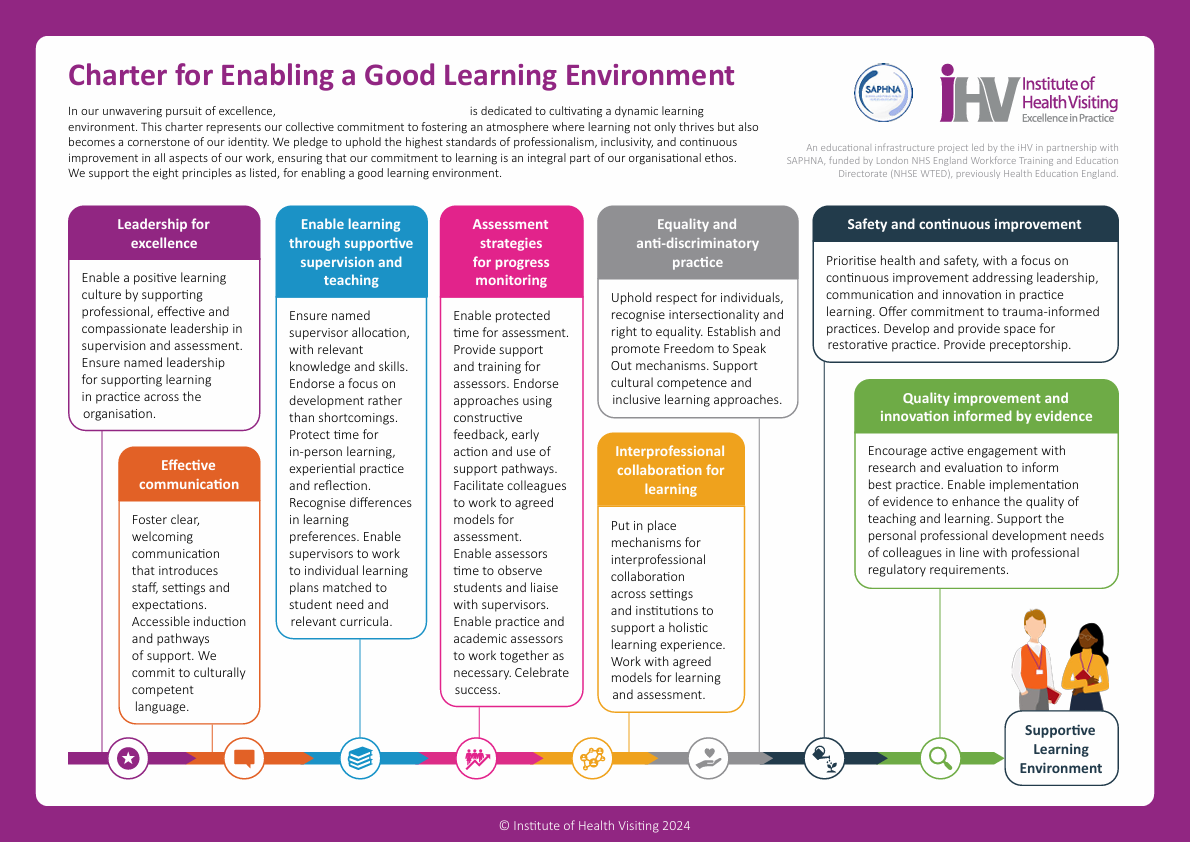
The Institute of Health Visiting (iHV) and the School and Public Health Nurses Association (SAPHNA) have collaborated to produce resources for Specialist Community Public Health Nurse (SCPHN) practice learning. Our organisations invite practice learning and employer partners to pledge their support for good learning environments by adopting the Charter.
The resources have been produced thanks to funding provided by London NHS England Workforce Training and Education Directorate (NHSE WTED), previously Health Education England. The suite of resources includes a Charter for enabling a good learning environment and a self-completion maturity matrix (available in portrait and landscape formats). They are tools for communicating a commitment to quality and appraisal of education within community settings.
iHV and NHS England Workforce Training and Education Directorate (NHSE WTED) published a new student SCPHN recruitment pathway development review report.
iHV was awarded funding by NHS England Workforce Training and Education Directorate (NHSE WTED) to complete a pathway development review of student Specialist Community Public Health Nurse (SCPHN) recruitment in London. The timing of this project was critical because the SCPHN health visiting and school nursing workforce was under enormous pressure due to significant national workforce shortages.
Workforce capacity issues have been further exacerbated by rising levels of need in the wake of the pandemic and the cost-of-living crisis. London was one of the hardest hit areas and services were struggling to fill significant gaps in SCPHN substantive posts. Across London, services also reported that they were struggling to recruit to student SCPHN places which is exacerbating the problem.
📄 Read the Pan-London report - Recruiting student SCPHNs in London: A roadmap to success
Professional Standards
Adherence to professional standards provides benefit employees and the public by ensuring safe, effective, and compassionate care.
The NMC professional standards provide a clear benchmark for professional practice, help professionals identify and address knowledge or skill gaps through continuing professional development (CPD), and uphold public trust by outlining what families can expect from their care providers.
The NMC’s evaluation, review and publication of the Standards of Proficiency for Specialist Community Public Health Nursing is part of its Programme of Change for Education.
- The iHV worked closely with partners to contribute to the development phase for the 2022 Standards of Proficiency for SCPHNs and the equivalent Apprenticeship Standard.
- We promote professional debate on core topics such as the future preparation and regulation of SCPHN practitioners.
- We engage and collaborate with national bodies such as UK Standing Conference on SCPHN education, HEE, HEIW, NES and professional organisations such as the QICN, SAPHNA, RCN and CPHVA on issues including practice education, skill mix, the future of professional regulation and advanced practice.
Skill Mix
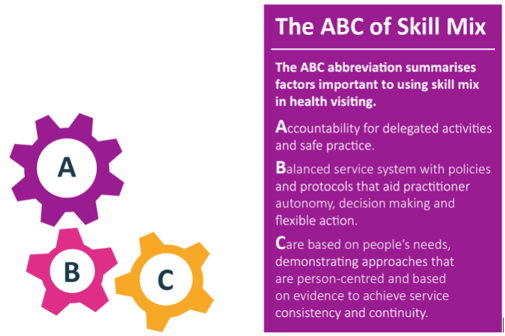
The iHV worked with a UK-wide reference group to produce a resource for practitioners, service managers and commissioners involved in skill mix decision making. The co-produced resource is the infographic on skill mix in health visiting.
Given the limited evidence for how skill mix in health visiting works, we have identified transferable messages from the broader skill mix literature and drawn on bodies of research evidence for what families want from services and what contributes to successful health visiting practice.
The collective messages from these bodies of evidence, have been distilled as the ABC of skill mix in health visiting to identify issues concerning: Accountability of health visitors; Balance in the service system; and Care based on people’s needs.
Stakeholder comments on the infographic:
“
{"markup":"“All the right themes have been highlighted in this piece of work. Relationship-based care and support of the family’s strengths take centre stage, as they should. Accountability is absolutely key, especially when some tasks are delegated. Overall, this helps everyone concerned be clear what families can expect and how their needs will be met.”","blocks":{"contentData":[],"settingsData":[]}}
Elizabeth Duff, Senior Policy Adviser, National Childbirth Trust (NCT)
“
{"markup":"“The infographic provides a clear and concise yet comprehensive overview of skill mix in health visiting. The approach supported by a robust evidence base provides a useful resource for service users and healthcare professionals and illustrates the added value skill mix brings to the Health Visiting team.”","blocks":{"contentData":[],"settingsData":[]}}
Sally Ashton May, Director for Midwifery Policy and Practice, The Royal College of Midwives
“
{"markup":"“We welcome this publication on the appropriate use of skill mix in health visiting services which will help towards ensuring the delivery of safe, quality and effective services through the alignment of skills and competencies across the workforce.”","blocks":{"contentData":[],"settingsData":[]}}
Sharon White OBE, CEO, SAPHNA
“
{"markup":"“This guidance from iHV is much-needed and very timely as different teams and services strive to provide personalised family-centred support for all parents and work collaboratively within the current constraints.”","blocks":{"contentData":[],"settingsData":[]}}
Sunita Sharma, Consultant Obstetrician and Gynaecologist, Chelsea and Westminster Hospital NHS Foundation Trust
“
{"markup":"“Distilling down key messages about a complex provision such as skill mix in health visiting can be challenging. This infographic recognises these challenges and tensions, providing a clear framework of the important factors for successful implementation. Of note is the emphasis on sill mix supporting care that is individualised, person-centred and based on evidence.”","blocks":{"contentData":[],"settingsData":[]}}
Melanie Farman, Development Manager – Enhanced Healthy Child Pathway & Specialist Services, Better Start
“
{"markup":"“A very comprehensive infographic capturing all of the elements required to deliver a safe and sustainable skill mix model. It clearly identifies the overarching service responsibility and accountability dimensions. Having implemented a skill mix model for a number of years this infographic can be used to guide and develop a skill mix service.”","blocks":{"contentData":[],"settingsData":[]}}
Clinical Practice Improvement Lead for Children’s Services, London
Career development
Enabling the development of careers is an important part of staff recruitment and retention. The iHV career pathway sets out health visiting career options. It draws on the NHS Long Term Workforce Plan’s priorities to “train, retain and reform” in order to build workforce capacity and capability and support practitioners to have worthwhile careers in health visiting.
📄 The Career Pathway for Health Visiting
Health visiting is a form of public health practice dedicated to creating good health. Health visitors embrace strengths-focused relational approaches and take account of the setting and circumstances impacting on a person’s life. These features, and the primary goal of health creation, define health visiting as a distinctive form of nursing and is an area of public health within which a whole career can be grown.
The Career Pathway for Health Visiting has been designed as a resource for workforce planning. It includes the different job roles contributing to health visiting provision and maps these against levels of practice that reflect registration status, educational development, expertise, and responsibility.
Please also see:
- ‘Becoming a health visitor’ to consider how to prepare for education and training as a health visitor;
- Our short iHV films “Health visiting in your community” and “Voices from Practice” to gain an insight into the breadth and depth of health visitors’ work with every family.